Master Modal Verbs in 7 Days: 2026 US English App Solution
Advertisements
A 2026 US-focused English app provides a practical solution for learners to master modal verbs efficiently within a condensed 7-day period, enhancing grammatical accuracy and communication fluency.
Are you ready to truly understand and confidently use modal verbs in American English? The challenge of mastering these nuanced grammatical tools can often feel overwhelming, but a revolutionary Practical Solution: Master Modal Verbs in 7 Days with This 2026 US-Focused English App is here to transform your learning journey. This innovative application promises to demystify modals, providing a clear, concise, and highly effective path to fluency for anyone looking to refine their English communication.
The modal verb challenge: why they’re so tricky
Modal verbs are essential components of English grammar, yet they often pose significant challenges for learners. Their subtle meanings and context-dependent usage can be a source of confusion, leading to errors in expressing possibility, necessity, permission, and ability. Understanding why these verbs are so tricky is the first step toward conquering them.
Many learners struggle because modal verbs don’t behave like regular verbs. They don’t take ‘-s’ in the third person singular, don’t have infinitive forms with ‘to’, and always precede a base verb. Furthermore, a single modal verb can convey multiple meanings, making their application complex in diverse conversational settings. This inherent flexibility is both their power and their puzzle.
Deciphering modal nuances
The subtle differences between modals like “can” and “could,” or “must” and “should,” often escape learners. “Can” typically expresses present ability or general possibility, while “could” suggests past ability, polite requests, or less certain possibilities. These distinctions require careful attention to context.
- Ability: Can, could, be able to
- Permission: Can, could, may, might
- Necessity/Obligation: Must, have to, should, ought to
- Possibility/Probability: May, might, could, can, would, should
Common pitfalls for American English learners
For those focusing on US English, regional idioms and common conversational patterns can add another layer of complexity. For instance, the use of “shall” is far less common in American English than in British English, often replaced by “will” or “should.” Misunderstandings can arise when learners apply rules learned from other English dialects.
- Over-reliance on direct translation from native language.
- Confusing formal vs. informal usage of modals.
- Struggling with negative and interrogative forms.
In conclusion, the difficulty of modal verbs stems from their irregular grammar, multiple meanings, and contextual dependencies. Recognizing these challenges is crucial for developing an effective learning strategy. The right tools, such as a specialized app, can simplify this intricate learning process.
Introducing the 2026 US-focused English app: a game changer
The year 2026 marks a significant leap in language learning technology with the introduction of an advanced US-focused English app designed specifically to tackle the complexities of modal verbs. This application is not just another language tool; it’s a meticulously crafted digital tutor that understands the specific needs of learners aiming for proficiency in American English.
Developed by leading linguists and software engineers, this app leverages cutting-edge AI and adaptive learning algorithms to provide a personalized learning experience. Its focus on US English nuances ensures that users are exposed to authentic language usage, preparing them for real-world conversations and academic requirements in the United States.
Personalized learning paths
One of the app’s standout features is its ability to create customized learning paths. Upon initial assessment, the app identifies areas where a user struggles with modal verbs and then tailors exercises and explanations accordingly. This adaptive approach ensures that learning is efficient and directly addresses individual weaknesses.
- Initial diagnostic tests to gauge current knowledge.
- AI-driven content adaptation based on performance.
- Progress tracking and personalized feedback loops.
Interactive and engaging content
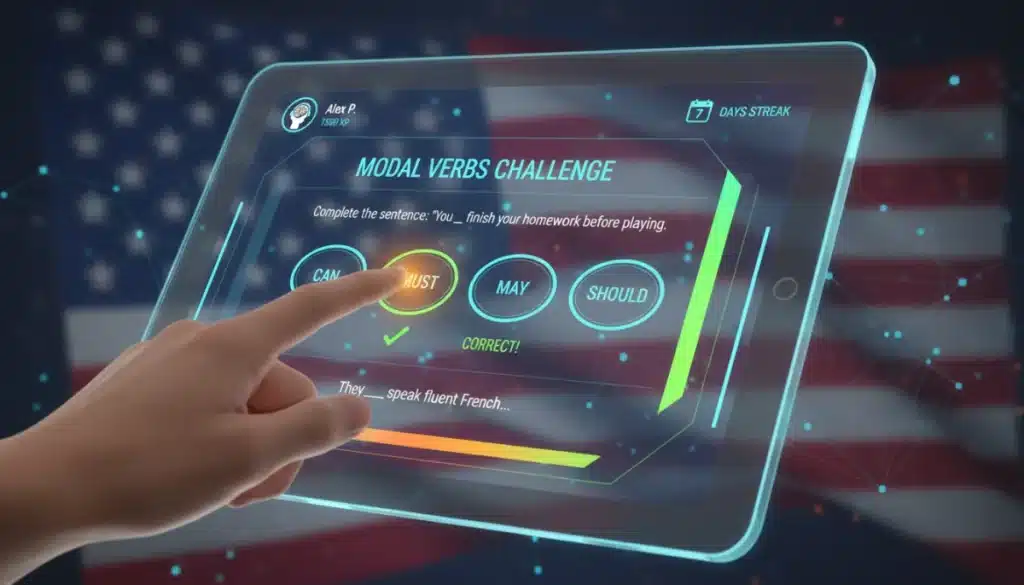
Gone are the days of dry grammar drills. The 2026 app incorporates a variety of interactive exercises, gamified challenges, and real-life scenario simulations to make learning engaging and fun. From conversational practice with AI interlocutors to fill-in-the-blank quizzes based on American cultural contexts, every activity is designed to reinforce understanding and retention.
- Speech recognition for pronunciation practice with modals.
- Role-playing scenarios for contextual usage.
- Gamified challenges with leaderboards and rewards.
In essence, this 2026 US-focused English app redefines how learners approach modal verbs. By combining advanced technology with a deep understanding of linguistic challenges, it provides an unparalleled tool for rapid and effective mastery.
The 7-day mastery plan: how the app accelerates learning
The promise of mastering modal verbs in just 7 days might seem ambitious, but the 2026 US-focused English app is specifically engineered to deliver on this claim through a structured, intensive, and highly effective learning plan. This accelerated approach is built on principles of spaced repetition, contextual learning, and immediate feedback, maximizing retention and application.
Each day of the program is carefully curated to introduce new modal verbs or deepen the understanding of previously learned ones, always within the context of American English usage. The app breaks down complex concepts into manageable daily lessons, preventing cognitive overload and fostering a sense of continuous achievement.
Daily module breakdown
The 7-day plan is not a one-size-fits-all curriculum; rather, it adapts to the user’s progress. However, a typical daily structure involves a combination of instructional videos, interactive exercises, and conversational practice. For example, Day 1 might focus on “can” and “could” for ability and possibility, while Day 3 could delve into the nuances of “must” vs. “have to” for obligation.
- Day 1-2: Introduction to core modals (can, could, may, might).
- Day 3-4: Expressing obligation and advice (must, have to, should, ought to).
- Day 5-6: Future and conditional modals (will, would, shall, should).
- Day 7: Comprehensive review and application in complex sentences.
Reinforcement and real-world application
Beyond rote memorization, the app emphasizes practical application. Users engage in simulated conversations, listen to authentic American English dialogues, and complete exercises that mimic real-life situations. This ensures that the learned grammar isn’t just theoretical but immediately usable.
- Contextual exercises simulating everyday US interactions.
- Audio examples from native American English speakers.
- Opportunities for continuous self-assessment and review.
By meticulously structuring the learning process and integrating advanced pedagogical techniques, the app ensures that users don’t just learn about modal verbs but truly internalize and master their usage within a remarkably short timeframe.
Key features tailored for US English learners
The 2026 English app distinguishes itself through a suite of features specifically designed for learners targeting US English. This specialization ensures that every aspect of the learning experience is relevant and accurate for the American linguistic landscape, from pronunciation to idiomatic expressions.
Understanding that US English has its own unique characteristics, the app meticulously integrates these into its curriculum. This includes variations in vocabulary, common phrases, and even the subtle intonations that differentiate American English from other dialects. The goal is to provide a truly immersive and authentic learning environment.
Pronunciation and accent training
A significant focus is placed on helping users develop an authentic American accent when using modal verbs. The app features advanced speech recognition technology that provides immediate feedback on pronunciation, helping learners refine their spoken English to sound more natural and confident.
- AI-powered pronunciation analysis for modal verb sentences.
- Comparison with native American English speaker audio.
- Targeted exercises for common American English intonation patterns.
Cultural context and real-life scenarios
Learning a language goes beyond grammar; it involves understanding the cultural context in which it is used. The app incorporates dialogues and scenarios that reflect common situations in American life, helping learners grasp not just the grammatical correctness but also the social appropriateness of modal verb usage.
- Dialogues based on American workplace, social, and academic settings.
- Examples from US media (movies, TV shows, news clips).
- Explanations of how modal usage can vary in different US regions.
In summary, the app’s commitment to US English specificity, from accent training to cultural integration, makes it an invaluable resource for anyone looking to achieve genuine fluency and confidence in communicating within an American context.
Beyond grammar: building confidence and fluency
Mastering modal verbs is not merely about grammatical accuracy; it’s about unlocking a higher level of confidence and fluency in English communication. The 2026 US-focused English app understands this holistic aspect of language learning and integrates strategies that extend beyond rote memorization to foster genuine communicative competence.
The app’s design philosophy centers on creating a supportive and interactive environment where learners feel empowered to experiment with language without fear of judgment. This approach is crucial for translating theoretical knowledge into practical, everyday usage, making the transition from learning to speaking seamless.
Simulated conversations and role-playing
One of the most effective ways to build confidence is through practice in a safe environment. The app offers AI-powered conversational partners that engage users in realistic dialogues, prompting them to use modal verbs naturally. Role-playing scenarios allow learners to practice various social interactions, from ordering food to discussing complex ideas.
- AI chatbots designed for natural, context-rich conversations.
- Scenario-based practice for job interviews, travel, and daily life.
- Immediate feedback on grammatical correctness and usage appropriateness.
Tracking progress and celebrating milestones
Seeing tangible progress is a powerful motivator. The app provides detailed analytics on performance, highlighting improvements in modal verb usage, vocabulary expansion, and overall fluency. Celebrating small victories, such as correctly using a specific modal in a complex sentence, reinforces positive learning behaviors.
- Visual progress dashboards and performance reports.
- Achievement badges and virtual rewards for milestones.
- Personalized tips for continued improvement and advanced learning.
Ultimately, the app transforms the often daunting task of learning grammar into an empowering journey of self-improvement. By focusing on practical application and confidence-building, it ensures that users not only master modal verbs but also become more fluent and articulate English speakers.
Success stories and testimonials: real-world impact
The true measure of any educational tool lies in its real-world impact, and the 2026 US-focused English app has already garnered significant praise from a diverse range of learners. These success stories and testimonials highlight the app’s effectiveness in helping individuals achieve their language goals, often within the promised 7-day timeframe.
From international students preparing for university in the US to professionals aiming to enhance their communication in American workplaces, the feedback consistently points to the app’s intuitive design, targeted content, and remarkable ability to demystify modal verbs. These personal accounts provide compelling evidence of the app’s transformative potential.
Student triumphs
“I used to dread using modal verbs,” says Maria, a student from Brazil now attending college in New York. “The app changed everything. In just one week, I felt so much more confident in my presentations and daily conversations. The US-specific examples were incredibly helpful.” Her experience is echoed by many who found the app instrumental in their academic success.
- Improved essay writing scores due to accurate modal use.
- Enhanced participation in classroom discussions.
- Greater understanding of complex academic texts.
Professional advancements
Carlos, a software engineer from Mexico working in Silicon Valley, shares, “My biggest challenge was expressing nuanced ideas in team meetings. This app helped me differentiate between ‘might,’ ‘could,’ and ‘should’ with precision. It’s truly a practical solution that boosted my professional communication.” His testimonial underscores the app’s utility in professional settings.
- More effective communication in business negotiations.
- Increased confidence in client presentations.
- Better understanding of workplace directives and expectations.
These testimonials are not isolated incidents but rather representative of a growing body of evidence demonstrating the app’s profound positive impact. The consistent theme is a significant increase in confidence and accuracy in using modal verbs, directly leading to improved academic and professional outcomes for users.
Getting started: download and embark on your 7-day journey
Embarking on your journey to master modal verbs in just 7 days is a straightforward process, designed to be as accessible and user-friendly as the app itself. The developers have ensured that getting started is quick, allowing you to dive into the learning experience without unnecessary delays.
The app is available on major platforms, ensuring broad compatibility for most users in the United States. With a simple download and registration process, you’ll be ready to unlock the power of modal verbs and significantly enhance your American English proficiency.
Downloading and installation
The 2026 US-focused English app can be found on both the Apple App Store and Google Play Store. Simply search for “Modal Verbs Master US” or a similar keyword to locate and download the application. The installation process is standard, taking only a few minutes to complete.
- Check device compatibility before downloading.
- Ensure sufficient storage space for the app and its content.
- Follow on-screen instructions for a smooth installation.
Initial setup and personalization
Upon first launch, the app will guide you through a brief setup process. This includes creating a user profile, setting your learning goals, and taking an initial diagnostic test. This test is crucial as it allows the app’s AI to tailor the 7-day plan specifically to your current level and learning needs.
- Create a user account (email or social media login).
- Complete the initial assessment to personalize your learning path.
- Explore the app’s interface and familiarize yourself with its features.
The ease of access and personalized onboarding ensure that you can immediately begin your intensive 7-day program. With this practical solution at your fingertips, mastering modal verbs and boosting your confidence in American English is now more achievable than ever before.
| Key Feature | Brief Description |
|---|---|
| 7-Day Mastery Plan | Structured, intensive curriculum for rapid modal verb acquisition. |
| US English Focus | Content, pronunciation, and scenarios tailored for American English. |
| Adaptive AI Learning | Personalized paths based on individual progress and weaknesses. |
| Interactive Practice | Gamified exercises, role-playing, and speech recognition for fluency. |
Frequently asked questions about mastering modal verbs
Modal verbs are challenging due to their irregular conjugations, multiple context-dependent meanings, and subtle nuances. Unlike regular verbs, they don’t change form for person or tense and always precede a base verb, requiring a deeper understanding of their function in expressing possibility, necessity, or permission.
The app accelerates learning through a structured 7-day plan, adaptive AI that personalizes content, and interactive exercises. It utilizes spaced repetition, real-world US English scenarios, and immediate feedback to maximize retention and ensure practical application, making the learning process efficient and engaging.
While primarily designed for intermediate to advanced learners who struggle with modal verbs, the app’s adaptive learning system can adjust to varying proficiency levels. An initial diagnostic test helps tailor the content, ensuring that both those needing fundamental understanding and those seeking refinement can benefit from its specialized approach.
The app incorporates authentic US English pronunciation, common idiomatic expressions, and cultural contexts prevalent in American daily life. It uses dialogues and scenarios reflecting US settings, ensuring learners are exposed to the specific linguistic patterns and nuances essential for effective communication in the United States.
Absolutely. The app features AI-powered conversational partners and role-playing scenarios that allow users to practice modal verbs in realistic dialogues. This safe practice environment, combined with immediate feedback and progress tracking, significantly boosts users’ confidence in applying modal verbs in natural, spontaneous conversations.
Conclusion
The advent of the 2026 US-focused English app represents a pivotal moment in language education, offering a definitive and Practical Solution: Master Modal Verbs in 7 Days with This 2026 US-Focused English App. By addressing the core challenges of modal verbs with a specialized, adaptive, and highly interactive approach, this application empowers learners to achieve not just grammatical accuracy but also genuine fluency and confidence in American English. Its tailored content, real-world scenarios, and emphasis on practical application make it an indispensable tool for anyone serious about mastering this crucial aspect of the English language. The journey to confident communication begins now, accessible and effective within a mere week.
