Unlock DNA Storage Apps 2026: Catalog’s Terabyte Tool Explained
Advertisements
DNA storage applications are poised for a significant leap in 2026 with Catalog’s introduction of a terabyte-writing tool, promising to dramatically enhance data efficiency through molecular-level storage advancements.
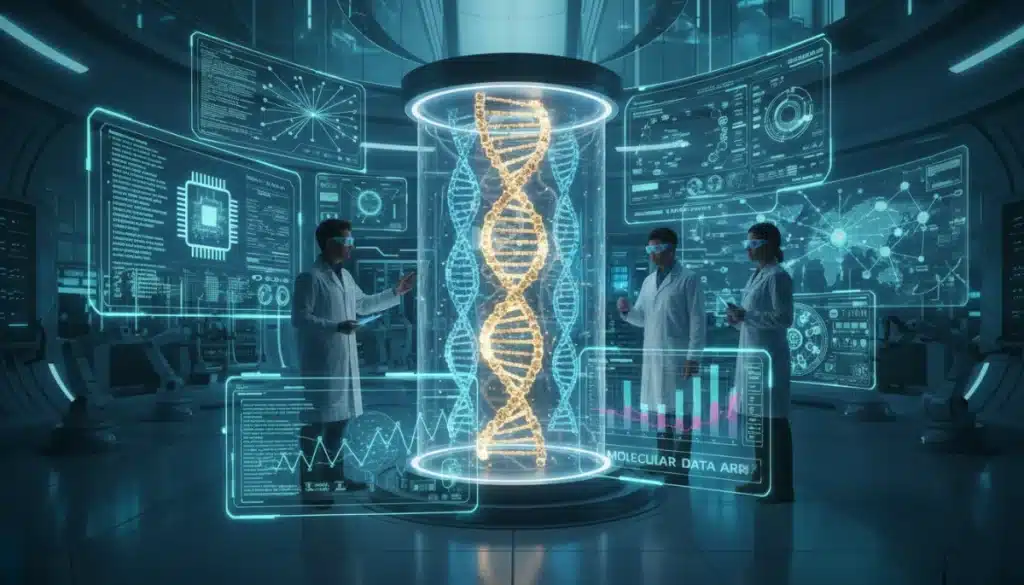
In an era defined by an insatiable demand for data, the quest for more efficient and durable storage solutions has become paramount. The year 2026 marks a pivotal moment for digital archiving, as DNA storage applications are set to redefine how we perceive and manage information. This guide delves into the transformative impact of Catalog’s groundbreaking terabyte-writing tool, a development poised to revolutionize data efficiency by harnessing the power of 500 trillion molecules.
The looming data crisis and the DNA solution
The digital universe is expanding at an exponential rate, generating zettabytes of data annually. Traditional storage methods, such as hard drives and magnetic tapes, are struggling to keep pace, facing limitations in capacity, longevity, and energy consumption. This escalating challenge has spurred innovation, leading researchers to explore unconventional yet highly promising avenues, with DNA emerging as a frontrunner.
DNA, the fundamental building block of life, offers an unparalleled density for information storage. A single gram of DNA can theoretically store all the digital data generated by humanity in a year. Its inherent stability and longevity, lasting for thousands of years under proper conditions, far surpass any current electronic medium. The concept of using DNA for data storage isn’t new, but the practical applications are now reaching a critical inflection point, moving from theoretical possibility to tangible reality.
Why traditional storage falls short
Current data storage technologies, while impressive, present several significant drawbacks in the face of ever-growing data volumes. These limitations drive the urgent need for a paradigm shift in how we store information.
- Limited Lifespan: Hard drives typically last 3-5 years, and even enterprise-grade tapes degrade over decades, requiring constant migration.
- High Energy Consumption: Maintaining vast data centers consumes enormous amounts of electricity, contributing to operational costs and environmental impact.
- Physical Footprint: The sheer physical space required for server farms and tape libraries is becoming unsustainable, especially in urban areas.
- Data Migration Burden: The continuous need to transfer data from older, failing media to newer systems is a costly and resource-intensive endeavor.
The promise of DNA storage directly addresses these critical shortcomings, offering a solution that is orders of magnitude more dense, durable, and potentially more sustainable in the long run. This shift represents not just an incremental improvement, but a fundamental re-imagining of data archiving for the 21st century and beyond.
In conclusion, the current data landscape necessitates a revolutionary approach. DNA storage, with its inherent advantages, stands as a beacon of hope against the backdrop of an impending data crisis, offering a sustainable and incredibly dense alternative to our increasingly burdened digital infrastructure.
Catalog’s breakthrough: a terabyte-writing tool
Catalog, a pioneer in synthetic biology, is at the forefront of translating DNA storage’s theoretical potential into practical reality. Their latest innovation, a terabyte-writing tool slated for 2026, marks a monumental leap forward. This technology isn’t just about storing data in DNA; it’s about doing so at an unprecedented scale and speed, making it viable for commercial and industrial applications.
The core of Catalog’s innovation lies in its ability to synthesize custom DNA sequences that encode digital information. Unlike natural DNA synthesis, which is focused on replicating existing genetic material, Catalog’s method involves creating entirely new strands from scratch, precisely embedding binary data (0s and 1s) into the sequence of adenine, guanine, cytosine, and thymine bases. This process, while complex, is becoming increasingly automated and scalable.
How the terabyte writer works
Catalog’s system employs a highly parallelized approach to DNA synthesis. Instead of synthesizing one long strand at a time, it leverages microfluidics and advanced chemistry to create millions of short DNA molecules simultaneously. Each short molecule carries a small piece of the overall data, along with indexing information to ensure accurate reconstruction.
The writing process involves several intricate steps:
- Data Conversion: Digital data is converted into a DNA-compatible code, translating binary information into sequences of DNA bases.
- Parallel Synthesis: Using a proprietary enzymatic process, millions of short DNA strands are synthesized in parallel, each containing a segment of the encoded data.
- Quality Control: Advanced error correction mechanisms are integrated throughout the process to ensure data integrity, mitigating the inherent challenges of molecular synthesis.
- Storage and Retrieval: The synthesized DNA is then stored in a highly stable, compact form. Retrieval involves sequencing the DNA and converting it back into digital data.
This terabyte-scale capability represents a significant milestone. It transitions DNA storage from being a niche, research-only endeavor to a technology with the potential to address real-world data archiving needs. The ability to write a terabyte of data, equivalent to over 200,000 high-definition movies, onto a minute amount of DNA signifies a new era of data management.
The development of this terabyte-writing tool is a testament to years of dedicated research and engineering, pushing the boundaries of what is possible at the intersection of biology and computer science. It paves the way for practical DNA storage applications.
Boosting data efficiency by 500 trillion molecules
The number 500 trillion molecules isn’t just a catchy statistic; it represents the sheer scale and molecular precision involved in Catalog’s DNA storage solution. This figure underscores the incredible density achieved when information is encoded at the molecular level, far surpassing the capabilities of any silicon-based storage medium. Each molecule acts as a tiny, durable information carrier.
This massive molecular efficiency translates directly into unparalleled data density. Imagine fitting the entire digital archives of a major corporation into a container no larger than a sugar cube. This is the promise that DNA storage, powered by Catalog’s innovation, brings to the table. The implications for long-term archiving, disaster recovery, and even space-constrained data storage are profound.
The molecular advantage
The efficiency gain comes from several factors inherent to DNA’s structure and Catalog’s method:
- Atomic-Level Storage: Information is stored at the atomic level within the DNA bases, providing the ultimate in miniaturization.
- High Redundancy: The parallel synthesis process allows for inherent redundancy, meaning multiple copies of data segments can be created, enhancing reliability.
- Low Energy for Archiving: Once written, DNA data requires minimal energy to maintain, unlike constantly powered electronic storage.
- Biocompatibility: DNA is a natural, biodegradable material, offering a more environmentally friendly alternative to rare earth minerals and plastics used in traditional media.
The ability to manipulate and encode information using hundreds of trillions of molecules allows for robust error correction and high data throughput. This ensures that even with the inherent complexities of molecular synthesis, the integrity of the stored data remains intact and reliable over extended periods. The precision at this molecular scale is what truly sets DNA storage apart.
Ultimately, this molecular-level efficiency translates into a significant reduction in physical footprint, energy consumption, and long-term maintenance costs for data archiving. The future of data storage is not just digital; it’s molecular, and Catalog is leading the charge.
Applications of DNA storage in 2026
By 2026, the practical applications of DNA storage, particularly with Catalog’s new tools, are projected to extend beyond theoretical demonstrations into real-world scenarios. While not yet a replacement for active, high-speed data access, DNA storage will become indispensable for long-term archiving and cold data storage, where data is rarely accessed but must be preserved indefinitely.
Industries generating massive amounts of archival data, such as scientific research, government institutions, and entertainment, stand to benefit immensely. Imagine preserving entire scientific datasets, historical records, or film archives for centuries without degradation or the need for constant migration. This long-term resilience is a game-changer for digital heritage.
Key application areas
The versatility and durability of DNA storage open doors to numerous critical applications:
- Archival Data for Scientific Research: Storing vast genomics data, astronomical observations, and climate models for future analysis.
- Government and Historical Records: Preserving national archives, legal documents, and cultural heritage for millennia.
- Media and Entertainment Archiving: Ensuring the perpetual availability of film, music, and digital art assets.
- Enterprise Cold Storage: Cost-effective, long-term storage for infrequently accessed but legally or historically important business data.
Furthermore, DNA storage could play a crucial role in space exploration, offering an incredibly compact and radiation-resistant method for storing mission-critical data on long-duration voyages. Its resilience to extreme conditions makes it an ideal candidate for extraterrestrial data preservation, where traditional media would quickly fail.
The strategic deployment of DNA storage applications in 2026 will focus on these high-value, long-term data sets, complementing existing digital infrastructures rather than replacing them entirely. It’s a specialized solution for a specialized problem: preserving humanity’s digital legacy.
Challenges and the path forward for DNA storage
Despite the remarkable progress, the widespread adoption of DNA storage still faces several significant challenges. These hurdles include the cost of synthesis and sequencing, the speed of writing and reading data, and the need for standardized protocols. Addressing these issues is crucial for DNA storage to move beyond specialized applications.
The current cost of synthesizing and sequencing DNA, while decreasing rapidly, remains higher than traditional storage methods for comparable active data volumes. For archival purposes, where data is written once and read rarely, the long-term cost benefits of DNA’s longevity begin to outweigh the initial investment. However, further cost reductions are essential for broader market penetration.
Overcoming technical and economic barriers
The industry is actively working on solutions to these challenges:
- Cost Reduction: Advances in enzymatic synthesis and microfluidics are continuously driving down the cost per base, making DNA writing more economical.
- Speed Enhancement: Research into faster, more parallelized synthesis and sequencing technologies aims to increase both write and read speeds.
- Standardization: Developing universal encoding schemes and data formats for DNA storage will ensure interoperability and long-term accessibility.
- Integration with IT Infrastructure: Creating user-friendly interfaces and protocols that allow seamless integration of DNA storage into existing data management systems.
Catalog’s terabyte-writing tool is a direct response to the speed and cost challenges, demonstrating that significant progress is indeed possible. As research continues to accelerate and new discoveries are made, the economic viability and practical applicability of DNA storage will only improve. The path forward involves continued collaboration between synthetic biologists, computer scientists, and data management experts.
In summary, while challenges remain, the trajectory of DNA storage is clear: continuous innovation and refinement will steadily overcome current limitations, paving the way for its integral role in the future of data preservation.
The future landscape of data with DNA storage
Looking beyond 2026, the integration of DNA storage applications promises to reshape the entire data landscape. We envision a future where digital data isn’t just stored in vast, energy-hungry data centers, but also in compact, stable molecular archives that can endure for centuries. This dual approach will optimize both active data access and long-term preservation.
The long-term implications extend to addressing concerns about digital obsolescence. As technology evolves, older digital formats and hardware become unreadable. DNA, as a universal biological molecule, offers a format-agnostic solution. As long as life exists, the ability to read DNA will exist, ensuring true perpetual archiving.
Transformative impacts and long-term vision
The widespread adoption of DNA storage will bring about several transformative changes:
- Reduced Environmental Footprint: Significantly lower energy consumption and physical space requirements for archival data.
- Enhanced Data Security: DNA is inherently difficult to corrupt or hack digitally, offering a new layer of physical security for sensitive information.
- Perpetual Data Preservation: A solution to the digital dark age, ensuring that humanity’s knowledge and records remain accessible for future generations.
- New Economic Models: The emergence of specialized DNA data storage services and infrastructure, creating new markets and job opportunities.
The vision is not to replace all digital storage but to create a complementary, highly efficient tier for data that needs to be preserved for extended periods. This hybrid approach, combining the speed of electronic storage with the longevity of DNA, will provide a robust and sustainable solution for the ever-growing demands of the digital age. The evolution of DNA storage applications is not merely a technological advancement; it’s a fundamental shift in our relationship with information itself.
In conclusion, the future of data management is intrinsically linked to the advancements in DNA storage. As Catalog and other pioneers continue to innovate, we move closer to a world where our digital legacy is as enduring as life itself.
| Key Aspect | Brief Description |
|---|---|
| Catalog’s Innovation | New terabyte-writing tool for DNA storage, enabling large-scale data encoding onto synthetic DNA. |
| Data Efficiency Boost | Achieves unprecedented data density and longevity by utilizing 500 trillion molecules for information storage. |
| Future Applications | Primarily for long-term archival storage in science, government, and media, complementing existing digital systems. |
| Challenges Ahead | Reducing costs, increasing write/read speeds, and establishing industry standards are key for broader adoption. |
Frequently asked questions about DNA storage
DNA storage involves encoding digital data (binary 0s and 1s) into the sequence of DNA’s four chemical bases: adenine (A), guanine (G), cytosine (C), and thymine (T). This synthetic DNA is then stored, and later sequenced to retrieve the original digital information. Its high density and stability make it ideal for long-term archiving.
Catalog’s terabyte-writing tool is significant because it dramatically increases the scale and speed at which data can be written into DNA. This moves DNA storage from laboratory curiosities to practical, commercial applications, enabling the efficient storage of massive datasets, which was previously a major bottleneck for the technology’s widespread adoption.
DNA storage offers unparalleled data density, allowing vast amounts of information to be stored in minuscule volumes. It also boasts extreme longevity, potentially preserving data for thousands of years without degradation, unlike electronic media that require constant power and migration. This reduces energy consumption and the physical footprint of data centers significantly.
Not entirely. DNA storage is not designed for active, high-speed data access. Instead, it is best suited for long-term archival or “cold” data storage, where information is accessed infrequently but must be preserved for decades or centuries. It will likely complement, rather than replace, existing hard drive and cloud solutions, forming a new tier in the data storage hierarchy.
Key challenges include the high cost of DNA synthesis and sequencing, the relatively slow write and read speeds compared to electronic storage, and the need for industry-wide standardization of encoding and retrieval protocols. However, ongoing research and technological advancements, like Catalog’s tool, are rapidly addressing these limitations, making DNA storage increasingly viable.
Conclusion
The emergence of advanced DNA storage applications, particularly with Catalog’s transformative terabyte-writing tool, signifies a monumental shift in our approach to data management. By 2026, we are witnessing the practical realization of molecular data storage, offering unprecedented density, longevity, and efficiency. This technology is not merely an incremental improvement but a fundamental re-imagining of how humanity will preserve its ever-growing digital legacy. While challenges in cost and speed persist, the rapid pace of innovation suggests that DNA storage will become an indispensable component of future data infrastructure, ensuring that our information endures for generations to come.
